Infrastructure demolition in Kentucky often happens where there is little room for error: beside active traffic lanes, near river crossings, within industrial facilities, or alongside occupied commercial properties. For teams planning concrete cutting, drilling, or controlled removal, https://bluegrassbit.com can be part of the conversation when identifying equipment and methods suited to demanding local projects.
Precision cutting is not simply a way to make cleaner openings. It helps project teams define what will be removed, estimate the weight of each section, protect adjacent construction, and coordinate lifting or lowering before the final release. That level of control is especially valuable across Kentucky, where weather, uneven terrain, waterways, and busy transportation corridors can all affect demolition logistics.
Why Precision Matters on Demolition Sites
Traditional breaking methods can be appropriate in open, isolated areas, but they may create unnecessary vibration, airborne debris, and unpredictable movement when a structure must remain partly in service. Defined cut lines allow crews to separate concrete, steel, masonry, or asphalt into manageable pieces and remove them in a planned sequence.
Consider a damaged bridge deck section beside an open lane. Rather than breaking the entire area at once, a crew may saw the deck into liftable sections, establish a protected work zone, and remove each piece after rigging is ready. This approach can help limit disruption and keep workers away from unsupported material. On roadway projects, Kentucky teams should also account for the traffic risks emphasized in Kentucky work zone safety guidance when scheduling work and establishing exclusion areas.
Choosing the Right Cutting Method
No single cutting method fits every demolition task. The right choice depends on the material, thickness, reinforcement, access, environmental limits, and removal plan. A method that works well for an open concrete slab may be unsuitable for a confined mechanical room, a marine structure, or an elevated bridge component.
- Materials such as concrete, reinforced concrete, steel, masonry, asphalt, and mixed assemblies respond differently to cutting tools.
- Access: Crews must consider equipment footprint, power supply, water access, overhead clearance, and safe operator positioning.
- Project limits: Noise, dust, vibration, heat, slurry, and nearby operations can affect the selection.
- Removal method: The planned piece may need to be lifted, lowered, slid, dismantled, or reduced in place.
Common Precision Cutting Methods
Diamond Wire Sawing
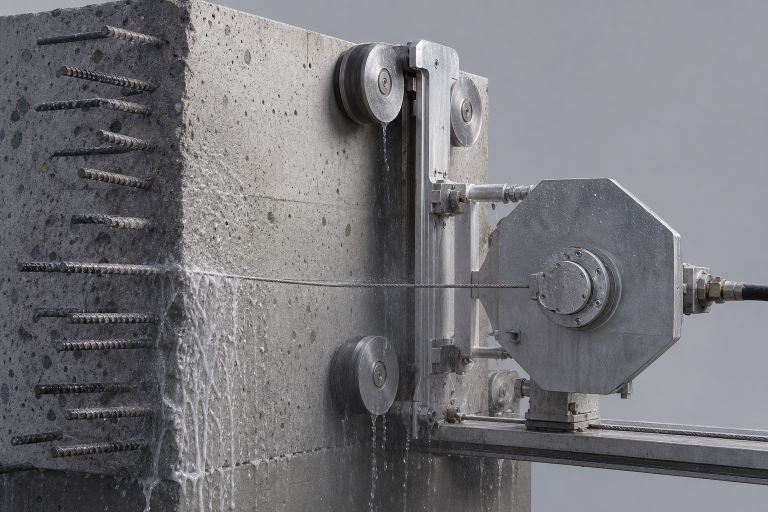
Diamond wire sawing uses a flexible wire to cut large or unusually shaped reinforced-concrete sections. It can be useful where a conventional blade cannot reach around the workpiece. The plan should address wire travel, water management, restricted access around the cutting path, and the section’s weight once it separates.
See also: Common Corporate Tax Mistakes Small Businesses Make
Wall Sawing and Track Sawing
Guided wall and track saws are commonly used for straight cuts in slabs, walls, bridge components, and structural openings. Because the equipment follows a set path, it can support accurate cuts while avoiding needless damage to nearby surfaces that must remain in place.
Core Drilling
Core drilling creates round openings for utilities, anchors, inspection work, and controlled structural modifications. Before drilling, crews should verify the location of reinforcement, conduit, post-tensioning components, and other embedded systems that could be affected.
Cold Cutting and Metal Removal
For steel removal near combustible materials or sensitive equipment, cold-cutting options may be preferable to heat-based work. The final choice should reflect the steel grade, thickness, access, fire risk, ventilation needs, and the condition of connected members.
Safety Planning Before Work Begins
Good demolition outcomes begin before the first tool is started. Project leaders should review drawings, inspection notes, scans, and repair records, then compare that information with actual field conditions. Hidden voids, added reinforcement, utility conflicts, and previous modifications can quickly change a removal plan.
- Confirm load paths and identify areas requiring temporary support.
- Locate utilities, rebar, cables, pipes, and embedded components.
- Mark approved the cut lines and connected them to the lifting plan.
- Set equipment locations, access routes, exclusion zones, and escape paths.
- Assign responsibilities for operators, spotters, signal persons, lift directors, and supervisors.
- Hold a pre-task briefing whenever the sequence or conditions change.
Managing Dust, Vibration, Noise, and Heat
Dust and environmental controls should be selected during planning, not after cutting begins. Concrete cutting can generate respirable crystalline silica, so employers should use the engineering controls and work practices described in OSHA’s construction silica information, including wet methods or local exhaust ventilation where applicable.
Water used for dust suppression also creates slurry that must be contained and cleaned before it dries or reaches drains, waterways, or equipment. Teams should also evaluate vibration near utilities and occupied areas, schedule noisy work thoughtfully, and address sparks, heat, ventilation, fire-watch requirements, and combustible materials before metal cutting begins.
Planning Controlled Removal and Lifting
A successful cut is only one part of the removal process. Before a section is released, the team should verify its estimated weight, balance point, approved lifting points, rigging arrangement, travel path, and landing location. Cutting before the crane, hoist, supports, or rigging are ready can leave a crew managing an unstable load.
Dividing a large slab into smaller sections can reduce handling demands, provided the revised pieces remain structurally predictable during cutting and lifting. Clear communication between the cutting crew and lifting team is essential, particularly when visibility is limited.
How Technology Supports Better Decisions
Digital tools can improve planning without replacing experienced supervision. Three-dimensional scans can reveal geometry and access limitations. Ground-penetrating radar and related locating tools can help identify embedded materials. Remote-controlled equipment may also increase separation between workers and hazards such as falling debris, dust, heat, and vibration.
A Practical Field Checklist
- Are drawings and field conditions current?
- Have hidden utilities and reinforcement been located?
- Is the cutting tool appropriate for the material and thickness?
- Are cut lines, supports, lifting points, and removal paths approved?
- Are water, dust, slurry, noise, and fire controls ready?
- Are exclusion zones visible, and do every worker know the stop-work signal?
Common Mistakes to Avoid
Common failures include choosing equipment based solely on cutting speed, overlooking the weight of a released section, dry cutting without appropriate controls, and allowing multiple crews to work under separate assumptions. Cleanup, runoff control, and waste handling also deserve the same planning attention as the cut itself.
A Safer Path Forward
Safer Kentucky demolition work depends on matching the cutting method to the structure, controlling each release, and maintaining clear communication from planning through final removal. Precision equipment supports that process, but sound engineering, trained workers, active supervision, and disciplined sequencing remain the foundation of a safer jobsite.