
Article summary: Fashion cycles have spent years chasing volume. Oversized silhouettes. Wide brims. Maximum presence. The docker hat is trending in the opposite direction: low crown, short forward peak, minimal brim, maximum intention. This piece looks at why compact headwear is gaining ground, what the docker hat specifically brings to that moment, and what it says about where casual dressing is heading.
Watch what is happening to the brim.
The wide brim fedora had its moment, and it was a good one. Statement headwear, presence at the top of the outfit, and enough silhouette to be visible from across a room. Fashion understood that and ran with it hard enough that by 2024 the wide brim was in every high street collection, every influencer’s autumn edit, and every “how to elevate your wardrobe” article.
And then, quietly, something else started appearing.
Short brim. Low crown. No drama. The docker hat, in its various regional names and iterations, began showing up in places that suggest it has moved from a subcultural staple to something more significant.

What the Docker Hat Is and Why Its Proportions Are the Point
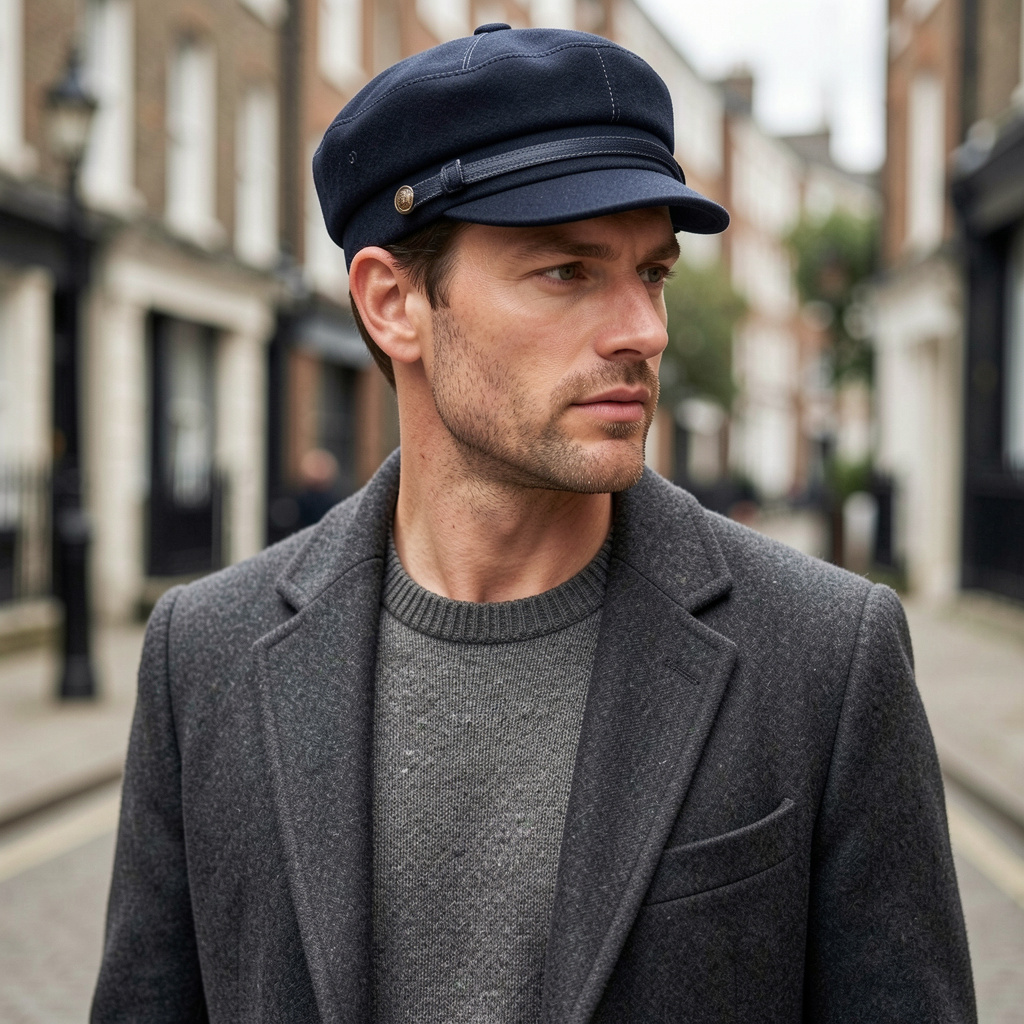
The docker hat sits low on the head. The crown is compressed rather than elevated. The brim projects forward at a slight upward angle, short enough to provide minimal shade and maximum visual sharpness. It is practically the opposite of wide brim dressing in every structural sense.
That compression is not a limitation. It is a character.
The docker hat takes up less visual space than any other hat style in regular use. It does not alter the silhouette dramatically. It does not demand that the outfit adjust around it. It simply sits on the head and sharpens everything beneath it in the specific way that compact, well-proportioned accessories always do.
Think of it alongside other fashion moments where reduction became the statement. The minimal sneaker displacing the chunky trainer. The understated bag replacing the logo-heavy tote. The plain rollneck over the printed shirt. The docker hat belongs to the same movement: less surface area, more intention.
Why Now
Timing in fashion is never entirely random and this trend is no exception.
Several things have converged. The workwear aesthetic that has been building for three years rewards honest, functional garments with clear origins. The docker hat comes from a working tradition as specific as the Barbour jacket or the Breton stripe: worn by dockers, market traders, and maritime workers for whom a hat needed to stay on in wind and stay out of the way of work. That functionality reads as authenticity in 2026, and authenticity is what workwear dressing is built on.
At the same time, the maximalist accessories cycle that peaked mid-decade is releasing its grip. Quieter choices are earning attention precisely because they are quieter. A hat that does not announce itself leaves more room for the outfit and the person wearing it to do the communicating.
There is also something specific happening in British fashion. A renewed interest in heritage, coastal, and working traditions. The docker hat is as British in character as any piece of headwear available. It does not feel borrowed or imported. It feels like it was always here, which is the most sustainable position any trend can occupy.
The Outfits Where It Works Best
The docker hat is directional enough to need the right context. It is not as forgiving as a flat cap in heritage tweed or a wool fedora in a neutral. It has a distinct character, and the outfit needs to reflect it.
For men: Dark straight-leg jeans or heavyweight cargo trousers, a dense cotton or wool knit in navy, grey, or off-white, a waxed cotton jacket or longline overcoat, leather boots or clean chunky trainers. The docker hat in navy or charcoal cotton or wool sits at the top of that outfit and gives it an urban-maritime edge that nothing else provides in quite the same way. Browse the men’s docker hats and harbour caps for the compact styles suited to this kind of contemporary workwear dressing.
For women: Wide-leg trousers in a dark linen or twill, a simple white or ivory shirt, a longline unstructured blazer in a warm neutral, and leather loafers. A pale canvas or natural cotton docker hat. The hat’s compactness sits in interesting contrast with the volume of the wide-leg trouser, which is exactly the kind of proportional tension that well-thought-out dressing produces.
The British Dimension
It is worth saying explicitly: this hat has a history in Britain that most wearers are unaware of.
The docker hat, the fiddler cap, the harbor cap: the names are regional, the object is consistent. It was worn across British working waterfront communities from Bristol to Glasgow, from Hull to the Thames Estuary, through most of the nineteenth century and well into the twentieth. It is not a global style that arrived in Britain. It emerged from British working life and stayed.
That is different from a hat that becomes fashionable in Britain because it became fashionable elsewhere. The Docker hat’s current visibility is, at least in part, a genuine rediscovery of something that belongs to British hat history. There is something satisfying about that. The women’s docker hats and fiddler caps collection sits within that heritage while offering the contemporary colourways and constructions that make it wearable in 2026 rather than merely referenced.
A Note on Who This Hat Is For
The Docker hat is not for everyone. No hat is.
It suits people whose dressing is already working with a degree of intention. It suits wardrobes that contain quality basics rather than trend-led pieces. It suits people interested in heritage aesthetics without being interested in costume. It suits cities, waterfronts, and the specific urban-utilitarian mood that has been building across menswear and women’s casual wear for the past few years.
Worn on a carefully assembled outfit in the right context, it is one of the most distinctive hat choices currently available because it reads as both knowledgeable and understated at the same time. That combination is rare. Fashion usually forces a choice between the two.
See also: Types of Switchgear Used in Industrial Power Distribution Systems
Frequently Asked Questions
What is the difference between a docker hat and a flat cap?
The Docker hat has a significantly shorter, stiffer brim that projects forward and slightly upward. The crown is lower and more compressed than a standard flat cap. A flat cap has a longer, softer peak and a fuller crown that gives it a more relaxed silhouette. Both come from British working traditions, but they carry different characters: the flat cap reads as rural and heritage, the docker hat reads as urban and maritime. Both are currently gaining ground in contemporary dressing for overlapping but distinct reasons.
Is the Docker hat suitable for women?
Yes. The docker hat’s compact proportions and low crown work well across genders, and women’s styling with the docker hat is increasingly present in contemporary fashion content. The key is the outfit context: structured separates, tailored trousers, and clean outerwear give the hat the right setting. Avoid very feminine or delicate outfit registers where the hat’s working character creates a mismatch. The contrast between a structured silhouette and a Docker hat is interesting. The contrast between a floaty dress and a docker hat requires more careful handling.
How do you wear a docker hat without it looking like a costume?
The costume reading comes from the outfit mismatch rather than the hat itself. A docker hat worn with other items that share its working, utilitarian, or maritime character reads as a coherent aesthetic choice. The same hat worn in an attempt to add character to an otherwise unrelated outfit reads as a prop. Keep the surrounding clothing in the same register: dense fabrics, honest construction, minimal decorative detail. The hat then reads as part of a vocabulary rather than as a word dropped in from a different language.
The docker hat is not a trend looking for a moment. It is a hat that had its moment for about a century, went quiet, and is now being rediscovered by people who needed something exactly like it without knowing it existed by name.
That is the best kind of revival.