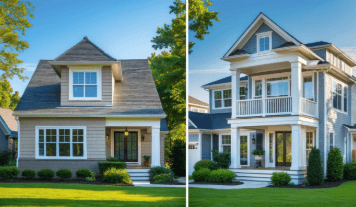
Dormer Additions vs. Full Second Story: A Cost and ROI Breakdown for Older Homes
Homeowners living in ranch-style houses, Cape Cods, and other single-story homes eventually face the same question: do we build up, or do we build partially up? When a family outgrows its footprint but loves the neighborhood, adding vertical space is often the most practical solution. But the decision between a dormer addition and a full second story involves more than just square footage. It comes down to budget, structural requirements, livability during construction, and long-term return on investment.
Understanding the Two Approaches
A dormer addition extends outward from an existing sloped roof, creating usable headroom and floor space within what was previously attic area. Dormers come in several styles — shed dormers provide the most interior volume, while gable dormers offer a more traditional aesthetic. The existing foundation and first-floor framing typically remain untouched.
A full second story addition removes or restructures the entire roof system and builds a complete new floor on top of the existing first story. This approach essentially doubles the home’s living space and transforms a ranch into a colonial or a Cape Cod into a full two-story home.
Cost Comparison: How the Two Stack Up
Dormer additions cost considerably less than a full second story, primarily because they work within the existing roof structure rather than replacing it entirely. The per-square-foot cost is typically a fraction of what a full build-up requires, and the overall project scope is smaller — most dormers add one to three rooms rather than an entire floor.
Full second story additions represent a significantly larger investment. The higher price tag reflects the structural engineering required to support an entirely new floor, the temporary roof removal, and the mechanical systems — HVAC, electrical, plumbing — that need to be extended or redesigned for the second level.
One variable that catches homeowners off guard is the foundation. Older homes were not always engineered to carry a full second story. A structural engineer may determine that reinforcement is needed before vertical construction can begin, adding a meaningful percentage to the overall project cost before framing even starts.
ROI: Which Addition Pays Back More?
According to Remodeling Magazine’s annual Cost vs. Value report, room additions and second-story additions typically recoup a significant portion of their cost at resale — though the exact percentage varies by market and project quality.
In suburban markets where inventory is tight and families are competing for homes with three or more bedrooms, a well-executed second story addition can push a home into an entirely new price bracket. Dormers tend to offer a stronger percentage return because the investment is lower and the added space — typically a bedroom, bathroom, or home office — fills a specific functional gap that expands the buyer pool at resale.
Livability During Construction
Dormers have a decisive advantage here. Because the work is confined to the roof and attic level, most families can continue living in the home throughout the project. A full second story is a different experience — once the existing roof comes off, the house is temporarily exposed to the elements. Many families relocate for part of the timeline, adding rental costs and logistical complexity to the budget.
See also: What to Expect from a Complete Home Automation Installation Process
When Each Option Makes Sense
Dormers are the right call when the goal is targeted: one or two additional rooms, a master suite carved out of attic space, or improved natural light on the upper level. They work particularly well on Cape Cod homes, where the existing roof pitch already accommodates partial second-floor space.
If the home needs three or more additional rooms, or if the first-floor layout would benefit from a complete reimagining — new staircase placement, reconfigured kitchen, open floor plan — then a full second story is the stronger long-term investment. Meigel Home Improvements, a family-owned remodeling company with a BBB A+ rating, handles both dormer additions and full second story conversions, managing the full scope from structural assessment through final finishes.
The Bottom Line
The right choice depends on how much space you need, how long you plan to stay, what your foundation can support, and how much disruption your family can absorb. Start with a structural assessment, get detailed estimates for both options, and make the decision based on your specific home.