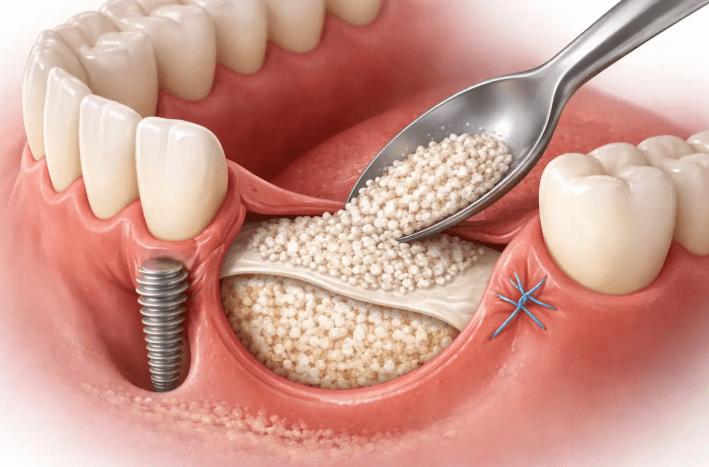
You may have heard that you need a bone graft before a dental implant, and that alone can feel like a lot. Then the terms start coming at you. Horizontal ridge augmentation. Vertical ridge augmentation. Ridge defects. Bone loss. It gets technical fast, especially when you are already trying to fix a missing tooth, a denture that does not sit right, or a smile that has changed more than you expected. A periodontist in Billerica, MA can help explain what these terms mean and what treatment may be right for you.
The core issue is simple. Horizontal ridge augmentation builds width when the jawbone has become too thin. Vertical ridge augmentation builds height when the bone has collapsed downward or upward and no longer has enough depth for a stable implant. Both procedures aim to rebuild the foundation, but they solve different problems, carry different levels of difficulty, and ask different things from healing.
Horizontal and Vertical Ridge Augmentation Treat Different Types of Bone Loss
After a tooth is lost, the jawbone starts to shrink. Sometimes it loses width first, leaving a narrow ridge that cannot hold an implant safely. That is where horizontal ridge augmentation comes in. The goal is to widen the ridge so the implant has enough bone around it for support and long term health.
Vertical ridge augmentation addresses height loss. This happens when the bone has resorbed to the point that there is not enough vertical dimension for implant placement. In real life, that can mean an implant would sit too close to important anatomy, or there simply is not enough bone to anchor it well. Restoring height is often harder than restoring width because the graft has to resist pressure from the surrounding soft tissue and maintain space during healing.
That difference matters. Width defects are often more predictable to treat. Height defects usually need tighter planning, stronger space maintenance, and closer follow up. Research on alveolar ridge augmentation techniques continues to show that both approaches can work well, but the method has to match the defect.
Vertical Ridge Augmentation Usually Demands More From Surgery and Healing
You feel this difference in the treatment plan. A narrow ridge may be corrected with guided bone regeneration, particulate grafting, block grafts, or ridge splitting in selected cases. A height defect may call for staged treatment, tenting methods, titanium reinforced membranes, autogenous bone, or other advanced grafting approaches. The surgery is often more technique sensitive because gravity, soft tissue tension, and blood supply all affect whether the graft holds its shape.
If you are weighing cost, time, and stress, this is often the point where the conversation gets real. Horizontal defects can still be serious, but vertical defects tend to involve more surgical complexity, longer healing, and a higher risk of partial graft loss or the need for revisions. A recent review on vertical ridge augmentation outcomes reflects that reality. Vertical gain is possible, but complication rates are often higher than with horizontal procedures.
That does not mean vertical grafting is a bad option. It means expectations need to be honest. If you have been told your case is “advanced,” that may simply reflect the biology of rebuilding lost height, not a sign that implants are out of reach.
Ridge Augmentation for Dental Implants Depends on Your Anatomy and Goals
Two people can lose the same tooth and end up needing very different treatment. One patient may have enough bone height but not enough width. Another may have severe collapse after years without the tooth, gum recession, or past infection. The plan changes with the shape of the defect, the condition of the soft tissue, the location in the mouth, and the final restoration.
Front teeth often raise the stakes because appearance matters as much as stability. Back teeth may involve bite forces and nearby sinuses or nerves. If you want a fixed implant and your bone has thinned or dropped away, ridge augmentation for dental implants can make that possible, but not every defect is best treated the same way or at the same time as implant placement.
Studies on guided bone regeneration in implant dentistry support a tailored approach. The material, membrane, flap design, and timing all influence the result. Good treatment planning is less about picking a trendy graft and more about matching the procedure to what your mouth can support.
Horizontal Vs. Vertical Ridge Augmentation Comparison
| Factor | Horizontal Ridge Augmentation | Vertical Ridge Augmentation |
|---|---|---|
| Main goal | Increase bone width | Increase bone height |
| Common problem treated | Thin jaw ridge after tooth loss | Collapsed ridge with inadequate implant depth |
| Typical predictability | Often more predictable | Often less predictable |
| Surgical difficulty | Moderate to advanced | Advanced |
| Healing demands | Usually lower soft tissue tension | Higher need for space maintenance and wound stability |
| Complication risk | Present, but often lower | Often higher, especially membrane exposure or graft loss |
| When used | Bone is wide enough nowhere near implant diameter | Bone height is too limited for safe implant placement |
This is why a generic “bone graft” quote does not tell you much by itself. The same phrase can cover a straightforward width correction or a much more demanding height reconstruction.
See also: Common Corporate Tax Mistakes Small Businesses Make
Clear Next Steps Help You Avoid the Wrong Procedure
Get a 3D scan and a defect specific diagnosis. A standard exam may suggest bone loss, but a CBCT scan shows whether the problem is width, height, or both. That changes the whole treatment plan.
Ask what the graft is trying to rebuild. You want a direct answer. Is the goal to widen the ridge, increase height, or support both hard and soft tissue for appearance? That one question cuts through vague explanations.
Choose a periodontist and implant dentist who does advanced grafting regularly. This is not just about placing an implant. It is about managing blood supply, flap tension, membrane stability, and healing over months. Experience matters most when the defect is vertical or combined.
The Right Bone Grafting Approach Starts With the Right Problem
If you are sorting through implant options and bone loss at the same time, your confusion makes sense. These terms sound similar, but they point to different structural problems. Horizontal augmentation rebuilds width. Vertical augmentation rebuilds height. One is often simpler. The other often asks more from surgery and healing. Both can play an important role in a strong, lasting implant result when the diagnosis is precise and the plan fits your anatomy.
You do not need to figure it out alone. Meet with a skilled periodontist and implant dentist, get clear imaging, and ask for a treatment plan that explains exactly what kind of ridge augmentation you need and why.