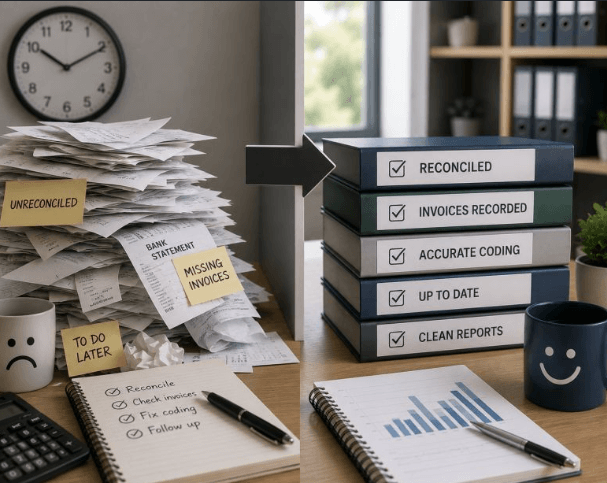
You get to the end of the year, open your books, and feel that drop in your stomach. A few transactions are uncategorized, owner draws are mixed with expenses, payroll numbers do not match what you expected, and one account has been off for months because there was never time to fix it. That stress is real. Most business owners are not behind because they do not care. They are behind because the year kept moving, which is why working with a CPA in Springfield, MO can help you get back on track.
The core issue is simple. If your books are not clean, your tax return is harder to prepare, easier to question, and more likely to cost you money in missed deductions, amended filings, or avoidable accountant cleanup. Year end bookkeeping for taxes is really about getting your records accurate enough that your return can be prepared from facts instead of guesswork.
A “tax return clean” set of books means your income is complete, your expenses are categorized correctly, your balance sheet accounts tie out, and your records can support what gets reported. The IRS expects businesses to keep records that clearly show income and deductions. Their recordkeeping guide for small businesses lays out that standard in plain terms.
Tax return clean books reduce stress, errors, and last minute surprises
Messy books usually do not stay small. One uncoded transfer can throw off owner equity. A duplicated deposit can inflate income. A loan payment booked as an expense can distort profit. When those errors stack up across twelve months, the tax return becomes a cleanup project instead of a filing process.
You might already know something is off because the numbers do not match your reality. Revenue looks too high, cash looks too low, or profit swings month to month with no clear reason. That gap matters. Tax preparation starts with the books, and if the books are wrong, every decision after that gets harder.
This is where a lot of business owners lose time. They start hunting through bank feeds, old receipts, and email threads in January or March, trying to reconstruct what happened in July. The emotional cost is just as real as the financial one. You are trying to run a business while also becoming your own forensic bookkeeper.
The IRS guidance for small businesses in Publication 334 connects bookkeeping directly to reporting income and expenses correctly. Sole proprietors also need their records to support items reported on Schedule C instructions, including cost of goods sold, vehicle expenses, contract labor, and home office deductions when applicable.
Year end accounting cleanup is not about making the books look nice. It is about making them usable. If your tax preparer has to stop and ask what ten transfers were, why retained earnings changed, or whether a payment was personal, you are paying for uncertainty. Clean books shorten that back and forth and lower the chance of filing with avoidable errors.
Common year end bookkeeping problems create tax risk
The most common problems are not dramatic. They are ordinary. Bank accounts are not reconciled. Credit cards have balances that do not match statements. Sales tax gets posted into income. Payroll tax payments are buried in wage expense. Fixed asset purchases are expensed in full when they should be tracked separately. Owner contributions and distributions end up in the profit and loss statement, which makes the business look more or less profitable than it really is.
Inventory businesses face another layer. If inventory counts are wrong, cost of goods sold is wrong. Service businesses often struggle with contractor payments, reimbursements, and mixed personal spending. If you use one card for everything, the cleanup work grows fast because each transaction needs a decision and, sometimes, proof.
What if your books show a profit, but you cannot see that cash anywhere in the bank? Often the answer sits on the balance sheet. Unreconciled loans, old outstanding checks, duplicate income entries, or unpaid liabilities can all create that disconnect. A clean tax file depends on understanding those balances, not ignoring them.
DIY cleanup and professional accounting firm support carry different costs
| Approach | Best Fit | Main Benefit | Main Risk |
|---|---|---|---|
| DIY year end cleanup | Very small books, low transaction volume, strong bookkeeping knowledge | Lower upfront cost | Misclassified items, missed deductions, more time spent, higher chance of rework |
| Hybrid approach with accountant review | Business owners who can organize records but want oversight | Balances cost and accuracy | Review can still take longer if reconciliations are incomplete |
| Full cleanup by an accounting firm | Backlogged books, payroll issues, loan activity, inventory, multiple accounts | Cleaner reporting, faster tax prep, clearer financial picture | Higher upfront fee if problems have piled up |
The cheapest option on paper is not always the least expensive in practice. If you spend fifteen hours sorting transactions and still hand over books that need corrections, you have paid twice, once with your time and once with cleanup fees. Professional accounting support usually pays off most when the books have not been reconciled monthly or when tax sensitive items like payroll, loans, and fixed assets are involved.
Three steps make your books tax return ready
Reconcile every cash account and credit card. Match each bank and card account to the year end statement balance. Do not estimate. If the account does not reconcile, find the missing or duplicate entries now. This is the backbone of tax ready bookkeeping.
Review the balance sheet, not just the profit and loss. Look at loans, payroll liabilities, sales tax payable, owner equity, fixed assets, and undeposited funds. Most year end errors hide there. If a number does not make sense, it usually points to a posting problem that also affects the tax return.
Gather support before tax prep starts. Pull loan statements, asset purchase records, payroll reports, contractor payments, mileage logs, inventory counts, and major receipts. When your documentation is together, your accountant can prepare instead of investigate.
See also: How to Choose the Right Bookkeeping Support for Your Growing Business
Clean books give you a clearer tax season
You do not need perfect books every month to finish the year well. You do need accurate books before the return is built on top of them. That is the difference between a filing season that feels controlled and one that turns into a scramble.
If your records are behind, mixed up, or simply not ready to support a return, an accounting firm can help you clean them up before tax mistakes get expensive. Get your books tax return clean now, while there is still time to fix the details with less pressure.